Why Is My CNIC Not Eligible for 8171? Reasons and What to Do
Quick Answer
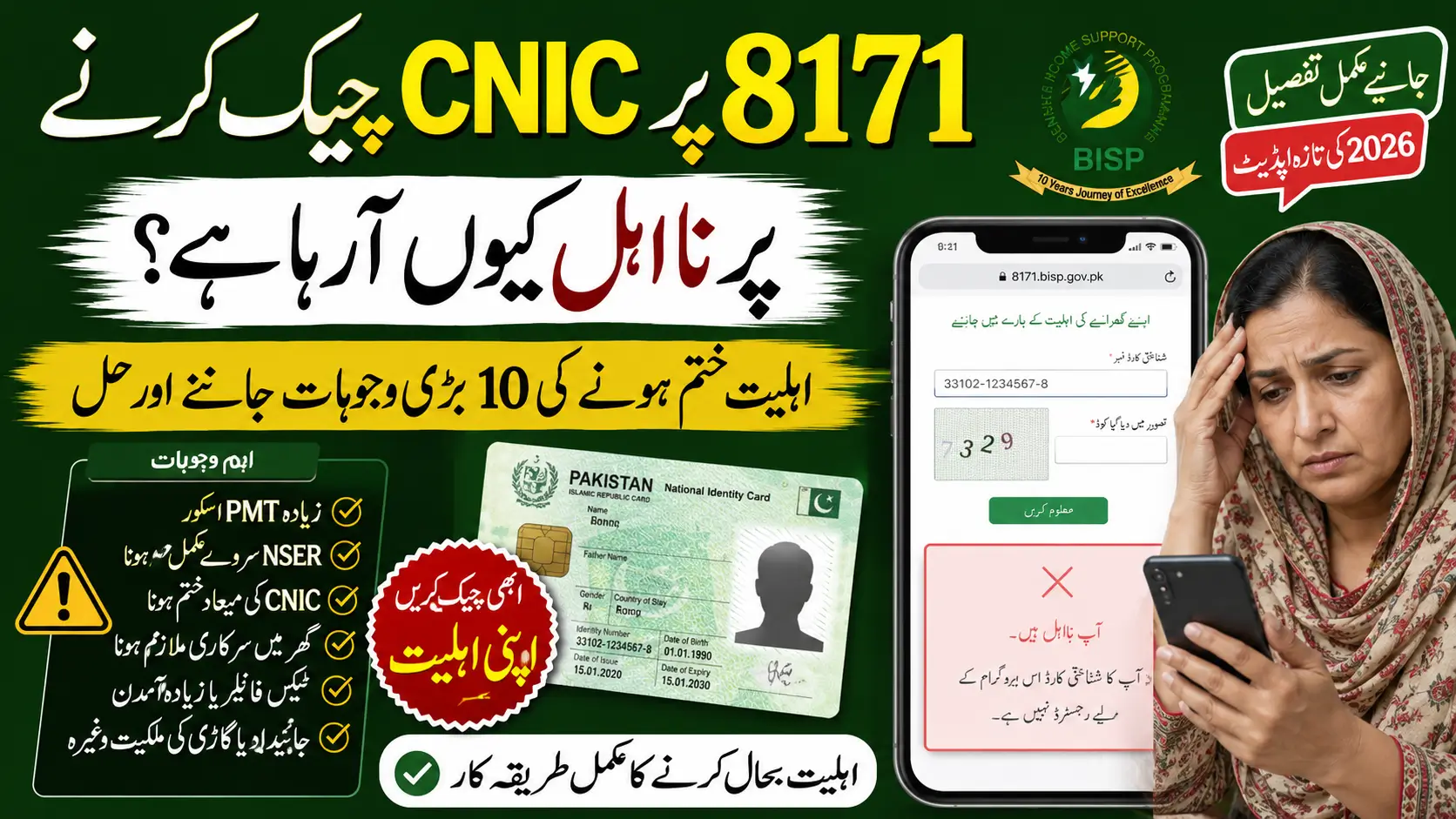
Your CNIC may show “Not Eligible” because your household information does not currently meet BISP criteria, your NSER record is outdated, or your information needs verification. You can ask BISP about the Dynamic Registry or re-survey process if your circumstances have changed.
If the 8171 BISP status check shows that your CNIC is not eligible, it does not necessarily mean that you can never qualify for BISP assistance. Your household may currently fall outside the program’s eligibility criteria, your socioeconomic information may need updating, or there may be an issue with your identity or household record.
BISP uses the National Socio-Economic Registry (NSER) to collect and maintain household information used for social-protection targeting. The Dynamic Registry allows eligible households to update information and allows new households to be included in the registry.
The first step is to check your status through the official 8171 web portal and, if your household information needs correction or updating, visit the relevant BISP Tehsil Office.
Check Your 8171 Status First
Before trying to fix your record, confirm exactly what the official system says. Use the official 8171 BISP portal:
You will need to enter your CNIC and the verification code displayed on the portal. The portal provides a way to check your household’s eligibility information. If the result is unclear, visit a BISP Tehsil Office rather than relying on an unofficial website.
Common Reasons a CNIC May Show “Not Eligible” for BISP
1. Your Household Does Not Currently Meet the Eligibility Criteria
BISP uses socioeconomic information to identify households for social-protection assistance.
If the information available about your household indicates that you do not meet the relevant eligibility criteria, the 8171 system can show a not-eligible result.
This does not mean that one particular item—such as owning a motorcycle or living in a particular type of house—automatically disqualifies everyone. Eligibility is based on the household assessment and the rules applicable to the relevant BISP program.
2. Your NSER Information Needs to Be Updated
The NSER is the database used by BISP to maintain socioeconomic information about households. BISP’s Dynamic Registry was introduced so household information can be updated and new households can be registered.
If your household circumstances have changed, such as family composition, marital status or other socioeconomic information, you should ask BISP whether your record is due for an update or resurvey.
3. Your Household Has Not Completed the Required Survey
If a household has not been surveyed or does not have the information required for an eligibility assessment, it may need to complete the relevant registration or survey process.
BISP’s Dynamic Registry provides a mechanism for households to register and update their information through designated BISP offices.
4. Your Information Does Not Match Official Records
BISP’s registry can use information linked with other government records, including NADRA-related household information.
A discrepancy in identity or family information can therefore require correction before your record can be properly assessed.
For example, changes involving:
- Marital status
- Birth or death records
- CNIC information
- Household members
- Children’s B-Forms
- Other NADRA-linked information
may need to be reflected in the relevant records.
BISP’s NSER documentation specifically includes updates such as CNIC, birth, death, marital-status and other household information.
5. Your Household Was Reassessed
BISP eligibility is not necessarily permanent.
BISP’s NSER framework provides for periodic socioeconomic updates. Existing beneficiaries can also be subject to recertification/reassessment after the applicable period. BISP has recently reminded beneficiaries who have completed three years of assistance to complete the required re-survey for continued eligibility.
This means a family that previously received assistance may later receive a different eligibility result after reassessment.
6. Your Household Information Has Changed
A change in household circumstances can affect the socioeconomic assessment.
For example, your household may have experienced changes in:
- Number of household members
- Employment or income
- Marital status
- Disability status
- Family composition
- Residential circumstances
- Other socioeconomic information recorded during the survey
If your information is no longer accurate, ask BISP whether an update is currently available for your household.
7. Your CNIC or NADRA Record Needs Correction
If your CNIC is expired or your personal information is incorrect, first resolve the identity issue through NADRA where necessary.
Do not assume that simply renewing a CNIC will automatically make you eligible for BISP. CNIC validity and BISP socioeconomic eligibility are separate matters.
8. Your Household Is Due for Recertification
Existing BISP beneficiaries may be asked to complete a re-survey or recertification.
BISP has stated that households that have completed three years of receiving assistance are required to undergo reassessment to determine continued eligibility.
If you receive an official instruction to complete a re-survey, follow it through the BISP system or your nearest BISP Tehsil Office.
Also Read> Cross Subsidy Program Online Registration 2026
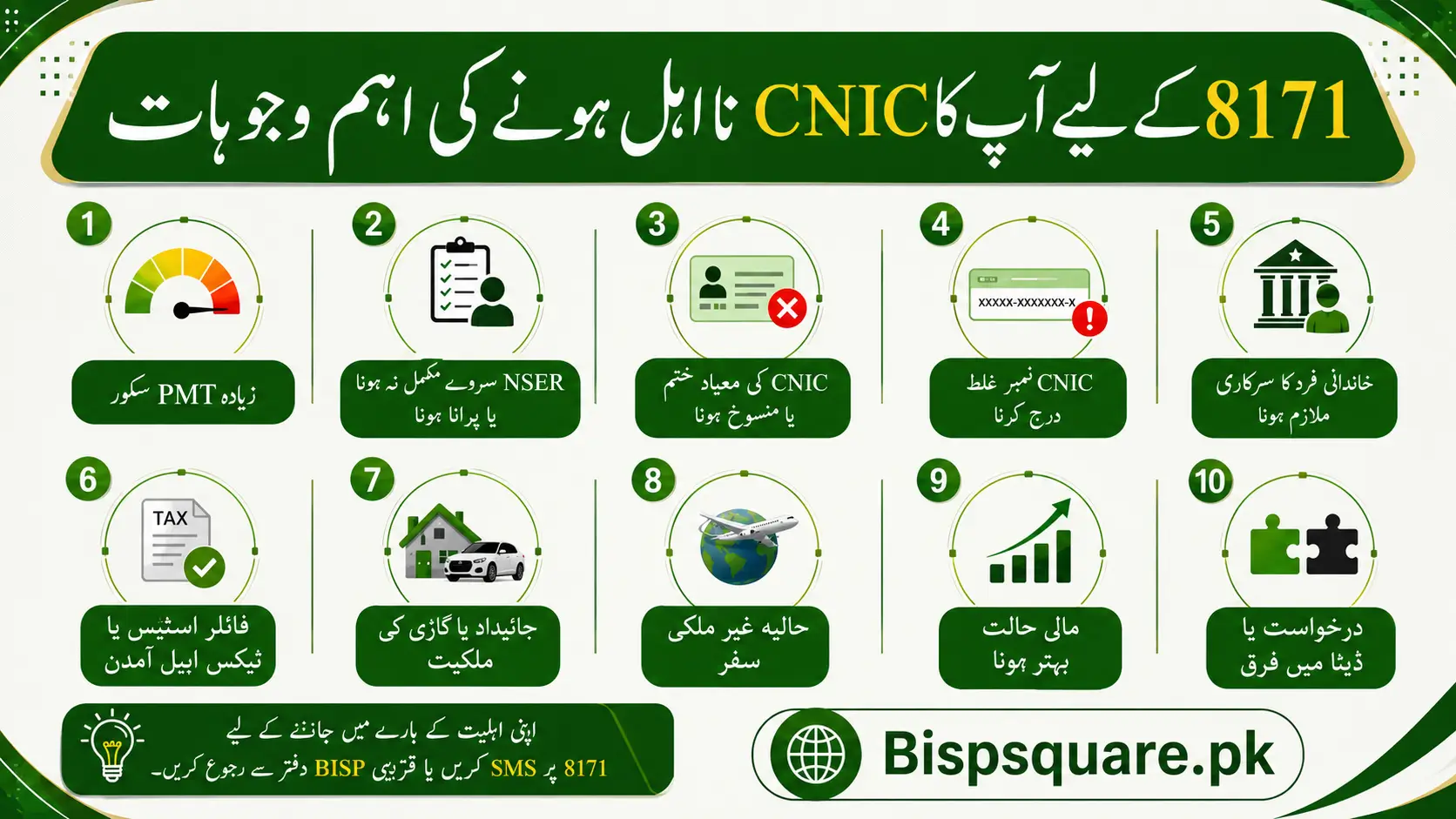
Quick Reference: Reasons and Their Solutions
| Reason | What You Should Do |
|---|---|
| High PMT Score | Request a Dynamic NSER survey update at the BISP Tehsil Office. |
| NSER Not Completed | Visit a BISP center and register through the new NSER survey. |
| Expired CNIC | Renew your CNIC at the nearest NADRA office. |
| Wrong CNIC Entered | Re-check the CNIC digits carefully and submit again. |
| Government Employee in Family | Eligibility may be affected if a household member is a government employee. |
| Tax Filer Status | Update your household income details during the NSER survey. |
| Property or Vehicle Owned | Report your correct asset status during the Dynamic Survey. |
| Foreign Travel Record | Provide the required explanation during the Dynamic Survey. |
| Financial Condition Improved | Your household may no longer meet the applicable eligibility criteria. |
| Data Mismatch with NADRA | Update your CNIC and family records at NADRA first. |
What Does a High PMT Score Mean?
The Proxy Means Test (PMT) is part of the socioeconomic targeting process used in BISP’s registry. In simple terms, the assessment is used to estimate the socioeconomic condition of a household from information collected through the survey.
A household whose assessment does not meet the applicable eligibility threshold may receive a not-eligible result. However, avoid relying on unofficial lists claiming that a particular car, mobile phone, school, electricity bill or single asset automatically produces a specific PMT score. The actual assessment depends on the information and methodology used by BISP.
Can You Become Eligible Again?
Possibly, but there is no guaranteed method to restore eligibility. If your household’s circumstances have changed or your existing information is incorrect, you can ask BISP about updating your Dynamic Registry information or completing the appropriate resurvey.
After BISP processes the updated information, your household can be assessed according to the applicable eligibility criteria. A new survey does not guarantee approval.
How to Fix an 8171 “Not Eligible” Problem
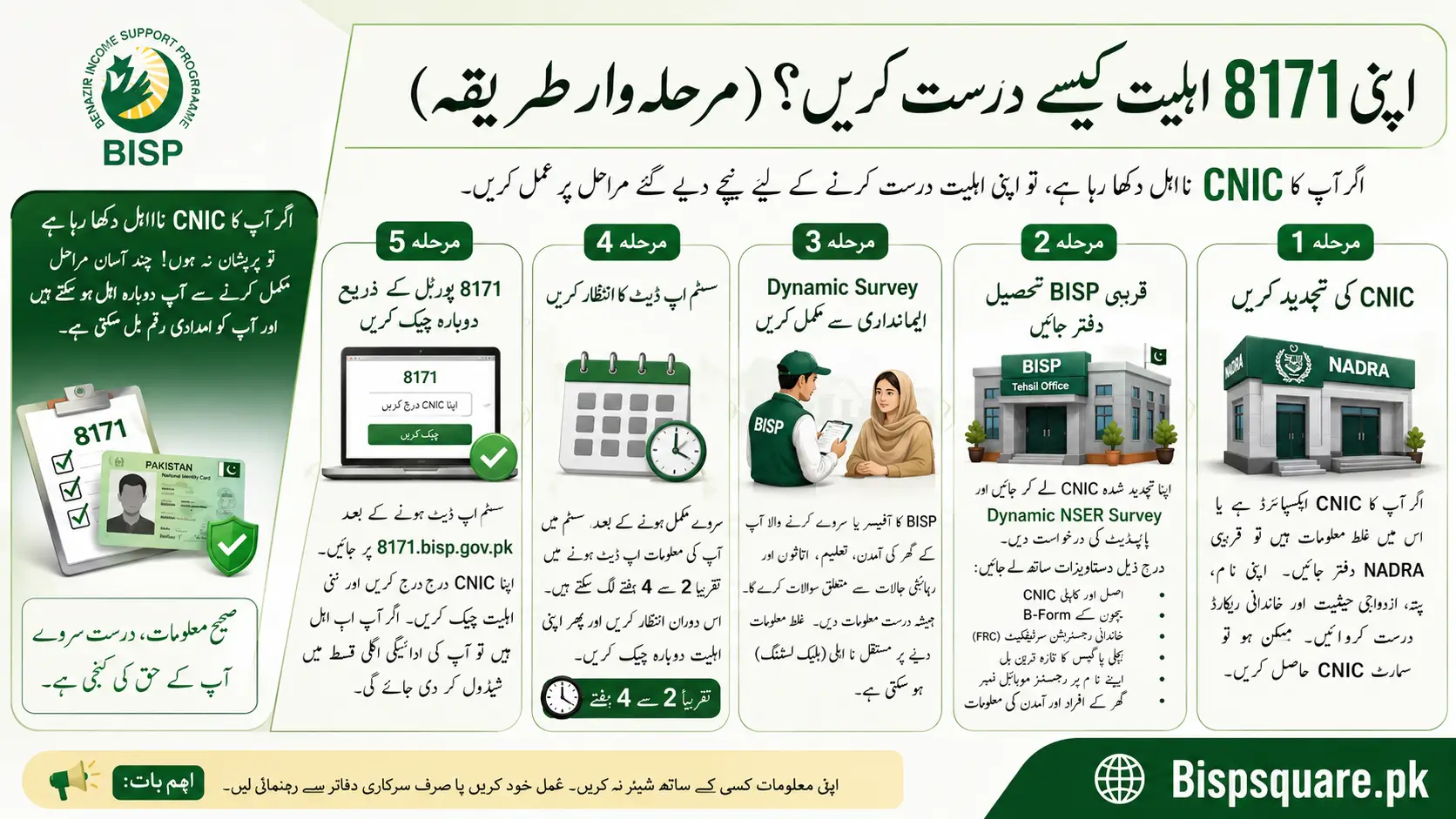
Step 1: Check the Official 8171 Portal
Start by checking your CNIC through the official portal.
Make sure you enter the correct CNIC number and verification code.
Step 2: Check Whether Your NADRA Information Is Correct
If your CNIC information or family record contains an error, resolve the relevant issue with NADRA.
Pay particular attention to major changes such as:
- Marriage
- Divorce
- Death of a household member
- Birth of children
- Incorrect CNIC information
- Family-record changes
Step 3: Visit a BISP Tehsil Office if an Update Is Needed
If your household needs registration, a survey update or clarification, visit the nearest BISP Tehsil Office. Take your original CNIC and any relevant family documents with you. BISP’s Dynamic Registry is designed to allow households to update their socioeconomic information and register where applicable.
Step 4: Provide Accurate Information
Answer the survey questions honestly. Do not hide income, household members, assets or other information simply to try to qualify. Your information should match the relevant official records wherever applicable.
Step 5: Wait for the Eligibility Assessment
There is no reliable universal timeframe that should be promised for a new eligibility decision. The result depends on the survey, verification and BISP’s processing and eligibility rules. Instead of trusting a person who promises a result within a fixed number of days, check the official 8171 system or contact BISP directly.
Also Read> Solar Panel Scheme 2026 Punjab
Documents You May Need
The exact documents required can vary depending on why you are visiting the BISP office. It is sensible to take:
- Original CNIC
- CNICs of relevant household members, where applicable
- Children’s B-Forms, where applicable
- NADRA family information or FRC if requested
- Relevant documents showing a change in household information
- Your active mobile number
Do not pay an agent to arrange a BISP survey. BISP has repeatedly stated that registration and survey services are free.
Why Your Previous BISP Payment Does Not Guarantee Future Eligibility
Receiving BISP assistance in the past does not mean that a household will remain eligible forever. The NSER framework includes periodic socioeconomic updates and recertification. BISP has specifically stated that existing beneficiaries may be required to undergo reassessment after three years.
Therefore, if your 8171 result changes from eligible to not eligible, the appropriate response is to check your household record and follow the official review or resurvey process—not to pay someone to alter the result.
What Not to Do
If your CNIC is showing “Not Eligible,” avoid these common mistakes:
- Do not pay an agent who promises to make you eligible.
- Do not provide false information during a survey.
- Do not create duplicate applications through unofficial websites.
- Do not share OTPs or security information with strangers.
- Do not trust messages claiming to be from BISP if they come from an unofficial number.
- Do not pay a survey fee.
- Do not assume that a social media list is an official BISP eligibility list.
BISP has confirmed that 8171 is the official number for BISP messages and that people should be cautious about messages from other numbers.
BISP Helpline and Official Help
If you cannot resolve the issue through the 8171 portal, contact BISP directly.
BISP Helpline: 0800-26477
You can also visit your nearest BISP Tehsil Office for assistance.
Frequently Asked Questions
Why does 8171 say my CNIC is not eligible?
It can mean that your household does not currently meet the applicable BISP eligibility criteria, or that your socioeconomic or household information requires updating or verification.
Can I apply again if I am not eligible?
You should not submit duplicate applications through random websites. If your household information has changed or needs updating, ask BISP about the applicable Dynamic Registry or resurvey process.
Does an expired CNIC automatically make me ineligible?
An expired or incorrect CNIC can create an identity-verification problem, but renewing your CNIC does not automatically make you eligible for BISP. Your household must still satisfy the relevant eligibility criteria.
Can I update my BISP survey?
Where an update or resurvey is applicable, BISP’s Dynamic Registry provides a mechanism for household information to be updated. Visit the relevant BISP Tehsil Office for guidance.
Which number sends official BISP messages?
BISP states that 8171 is the official number used for BISP messages. Messages claiming to be from BISP through other numbers should not be trusted.
I was eligible before but now 8171 says not eligible. Why?
Your household may have been reassessed, or the information used for the current assessment may differ from the information used previously. BISP’s system includes periodic socioeconomic updates and recertification of existing beneficiaries.
Can an agent increase my PMT eligibility score?
No legitimate agent can guarantee or sell BISP eligibility. Do not pay anyone who claims they can manipulate your PMT score or change your 8171 status.
Final Words
A “Not Eligible” result on 8171 is a status, not something that should be changed by an agent or unofficial website. First, check your status through the official 8171 portal. If your household information is outdated or incorrect, contact BISP and ask about the appropriate Dynamic Registry or resurvey process. Keep your CNIC and family information accurate, provide truthful information during any survey, and do not pay for registration or eligibility.
For reliable information, use the official BISP website, the 8171 portal and BISP’s helpline rather than third-party messages or social media claims.